
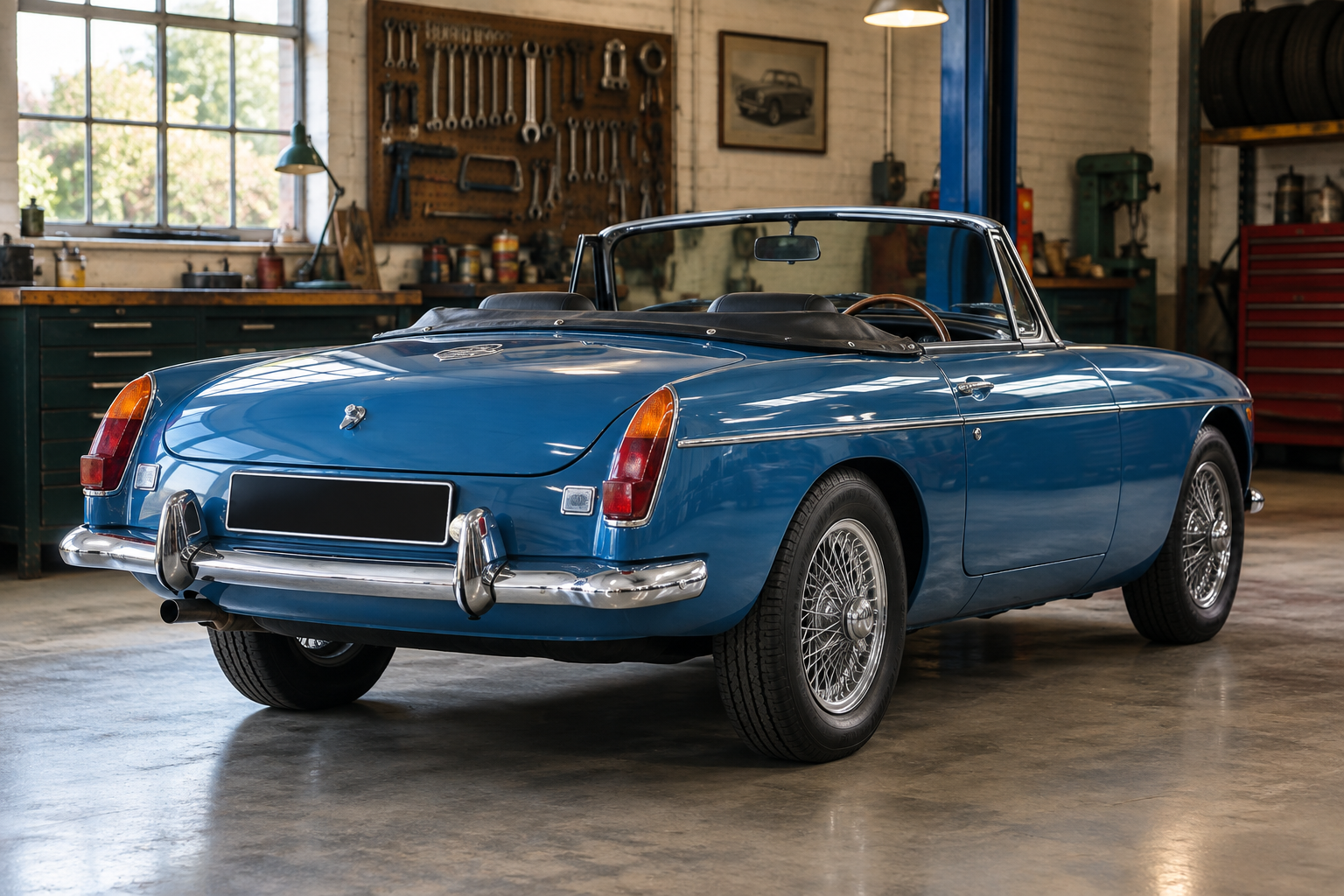
An MGB gearbox has a considerable influence on the character of the car. It affects how the engine feels, how easily the car keeps pace with modern traffic and how enjoyable it is on a longer drive. For many owners, the original transmission is entirely suitable. For others, an upgraded gearbox can make the car more comfortable and more usable without losing its classic character.
There is no single best gearbox for every MGB. The appropriate choice depends on the engine, axle ratio, intended use, body style, wheel and tyre specification, and the owner’s expectations. A roadster used mainly on local roads may need a different solution from a GT covering regular motorway journeys. A standard engine also places different demands on the transmission from a tuned four-cylinder unit or an MGB V8 conversion.
This guide explains the main decisions involved. It is not a substitute for checking a particular car in detail, but it should help you understand the questions that need to be answered before selecting or commissioning an upgraded gearbox.
Why consider an upgraded MGB gearbox?
The original MGB transmission was designed for the performance and driving conditions of its period. When the car is maintained correctly, it can provide a direct and satisfying driving experience. However, modern traffic and contemporary road use may expose some limitations.
A replacement or upgraded gearbox may offer closer or more suitable ratios, a stronger construction, improved shift quality, or a higher top gear for relaxed cruising. It can also be considered when an existing gearbox is worn, damaged or no longer appropriate for an engine conversion.
The important point is that an upgraded gearbox should solve a defined problem. If the aim is quieter cruising, the ratio selection matters. If the aim is coping with increased torque, strength and clutch compatibility become more important. If the existing transmission is simply difficult to select, rebuilding or correctly setting up the original unit may be the more sensible route.
Start with the car’s intended use
Before comparing gearbox types, describe how the MGB will actually be driven. Consider the proportion of local roads, A-roads, motorways, touring and occasional spirited driving. Also consider whether the car will be used with passengers and luggage, and whether it will spend long periods in traffic.
For a mostly local-use MGB, the standard ratios may already suit the car well. A lower first gear is not necessarily an advantage if it makes the gap between first and second feel less natural. Equally, a very tall top gear may leave a standard engine working below its most comfortable range.
For longer journeys, a higher cruising ratio can reduce engine speed and make sustained travel more relaxed. The benefit depends on the engine’s torque characteristics, the rear axle ratio and the rolling circumference of the tyres. Gearbox choice should therefore be considered as part of the complete drivetrain rather than as an isolated component.
Ratios, cruising speed and engine characteristics
Gear ratios determine how engine speed is converted into road speed. A close-ratio gearbox keeps the engine within a narrower operating range between changes, which may suit a tuned engine or a driver who values responsive acceleration. Wider ratios can be easier to live with in ordinary road use, particularly where smooth progress matters more than extracting maximum performance.
The top gear requires particular attention. A taller top gear can lower engine speed at a given road speed, but it does not automatically make the car better. If the engine lacks sufficient torque, frequent downchanges may be needed on inclines or when overtaking. A V8 conversion may tolerate a higher cruising ratio more comfortably than a standard four-cylinder engine, but the precise result still depends on the engine build and rear axle.
It is useful to calculate the likely engine speed in each proposed top gear before making a decision. This can be done using the gearbox ratio, differential ratio and tyre rolling circumference. The calculation will not predict every aspect of drivability, but it helps identify combinations that may be too short or too tall for the intended use.
Overdrive or a five-speed gearbox?
For many MGBs, the choice is between retaining or adding an overdrive-equipped transmission and converting to a five-speed gearbox. Both approaches can provide a higher cruising ratio, but they create different driving characteristics and installation requirements.
An overdrive gearbox retains much of the traditional MGB driving experience. The additional ratio is engaged through a switch, allowing the driver to select it without moving the main gear lever. This can be especially pleasant on undulating roads, where the driver may alternate between direct and overdrive top gears.
A five-speed gearbox provides an extra ratio through the main gear lever. Depending on the chosen unit and its ratios, it may offer a useful intermediate gear spacing as well as a relaxed top gear. It can be a practical option when a car is being rebuilt or when the original gearbox is no longer suitable for the engine specification.
Neither arrangement should be selected solely because it offers more gears. The quality of the conversion, the accuracy of the ratios, the position of the gear lever and the compatibility of the surrounding components all influence the finished result.
Strength and torque capacity
Torque capacity is a central consideration when choosing a gearbox for an upgraded MGB. A standard transmission may be entirely adequate behind a standard engine, but increased torque, more frequent hard acceleration or different use can alter the loads placed on the gears, bearings, shafts and differential.
Engine output figures alone do not tell the whole story. The way torque is delivered, the grip available from the tyres, the rear axle ratio and the driver’s habits all affect transmission loads. A powerful engine combined with progressive throttle response may be easier on its gearbox than a less powerful engine subjected to repeated abrupt engagement.
For an MGB V8, gearbox selection deserves particular care. The bellhousing, input shaft, clutch, propshaft and mounting arrangements must all be compatible with the chosen engine and transmission. The differential and rear axle should also be considered, since strengthening one part of the drivetrain can reveal weaknesses elsewhere if the complete system is not assessed.
Clutch, bellhousing and installation details
A gearbox conversion is more than a matter of fitting a replacement casing into the tunnel. The clutch must match the gearbox input shaft and release mechanism, while the bellhousing must position the gearbox correctly in relation to the engine. The starter arrangement, flywheel, crossmember, gearbox mount and propshaft may also require attention.
Gear lever position is another practical issue. A change in gearbox length or selector location can affect the transmission tunnel and the position of the lever within the cabin. The finished result should be comfortable to use and should not leave the lever fouling the dashboard, centre console or seat.
Clearance matters underneath the car as well. Exhaust routing, wiring, heat protection and tunnel modifications should be planned rather than improvised. Any alteration to the shell should be approached carefully, particularly where future servicing or access may be affected.
A well-executed installation should also account for alignment. The engine, gearbox and propshaft need to work together without introducing unnecessary angles or vibration. New mounts, bushes and fasteners should be selected as part of the installation rather than treated as minor afterthoughts.
Shift quality and everyday usability
On a road car, shift quality can matter as much as strength. A gearbox that is difficult to select, notchy when cold or vague at the lever may undermine the benefit of the conversion. The condition of the selector mechanism, remote housing, bushes and linkage should be checked alongside the gearbox itself.
Synchromesh performance is important for normal driving. A driver should not have to force a gear or rely on excessive rev matching simply to make smooth progress. At the same time, an upgraded gearbox may have a different shift feel from the original unit, and owners should understand that a more positive action is not necessarily a fault.
Noise and vibration should also be considered. A different gearbox, mounting arrangement or propshaft can alter the sound transmitted into the cabin. Correct alignment, balanced rotating components and suitable insulation can help, but the classic MGB will never behave exactly like a modern saloon.
Matching the gearbox to the rear axle
The gearbox and rear axle work as a pair. A short differential ratio combined with a short top gear may produce a busy car at cruising speed. Conversely, a tall differential and tall top gear may make the engine feel flat or reluctant in ordinary use.
Tyre size also influences the effective gearing. A larger rolling circumference increases road speed for a given engine speed, while a smaller circumference has the opposite effect. This is one reason why a gearbox that feels suitable in one MGB may not produce the same result in another.
Before ordering parts, record the existing axle ratio if known, the tyre size and the engine’s approximate cruising behaviour. These details give a more useful starting point than comparing gearbox names in isolation.
What to check on an existing upgraded gearbox
If you are buying an MGB that already has a non-standard gearbox, ask what has been fitted and how the installation was completed. Look for evidence of careful mounting, sound propshaft alignment and sensible clearance around the transmission tunnel and exhaust.
During a road test, listen for bearing noise, whining that changes with gear selection, rumbling under load and vibration that increases with road speed. Check that every gear can be selected cleanly when cold and warm. Test the clutch for smooth engagement and confirm that the gearbox does not jump out of gear under acceleration or overrun.
Documentation can be useful, but the physical condition of the installation remains important. If the exact gearbox, ratios or conversion components cannot be established, a specialist inspection may be worthwhile before committing to major work.
Planning a gearbox upgrade during a rebuild
The most convenient time to install an upgraded gearbox is often when the engine, interior or body is already being removed, because access is improved and related work can be coordinated. That does not mean every rebuild needs a different transmission. The decision should still be based on the finished car’s intended use.
Discuss the complete specification before work begins. This should include the engine, clutch, gearbox, rear axle, brakes, suspension, wheels and exhaust. A written build specification can help prevent incompatible parts being selected at different stages. For an indication of the areas that may be considered in a comprehensive MGB project, see the MGB rebuild specification.
Owners considering a particular conversion can also contact California Classics (Hull) Ltd to discuss the intended use and the existing car. The useful starting point is not simply the desire for more gears, but a clear understanding of how the MGB should drive when complete.
The best gearbox is the one that suits the whole car
An upgraded MGB gearbox can improve long-distance comfort, shift quality or drivetrain suitability, but it should be chosen with restraint and purpose. Ratios, torque, clutch compatibility, axle gearing, installation quality and future maintenance all matter.
For some cars, a properly rebuilt original gearbox is the right answer. For others, an overdrive unit or five-speed conversion may better match the owner’s plans. The strongest result is usually achieved when the gearbox is treated as one part of a coherent specification rather than as a standalone upgrade.
Whether you are planning a rebuild or looking at completed examples, reviewing current MGB stock and previously sold cars may help you compare different approaches to specification and presentation.